The Overlooked Risk Zone: Rethinking Hygiene in Non-Clinical Healthcare Spaces
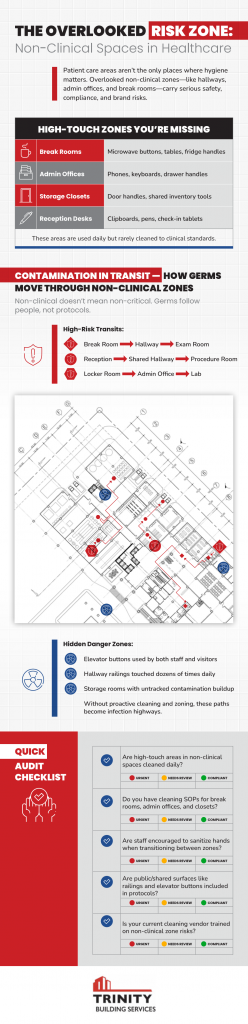
In healthcare settings, most of the focus is placed where it’s expected — patient rooms, exam areas, and surgical instruments receive strict sanitation protocols. Yet, there are other parts of the facility that, while non-clinical, play a vital role in overall hygiene and are often overlooked. Spaces like hallways, staff lounges, front desks, and administrative areas are frequented just as often and can quietly compromise a facility’s cleanliness standards.
These areas aren’t just transitional spaces or places for a coffee break — they’re the arteries of the facility, constantly used by staff moving in and out of treatment areas. Because of this constant flow, they can unknowingly contribute to cross-contamination. The items and surfaces in these zones can carry contaminants from one area to another, putting both employees and patients at risk.
Healthcare isn’t solely about diagnostics and procedures — it’s also about creating an environment that supports recovery and well-being. Cleanliness should extend beyond just clinical zones, encompassing the full footprint of the facility to uphold that goal.
A patient’s perception begins the moment they walk through the door. If a reception area looks neglected or surfaces along a corridor are dusty, it can quietly undermine the sense of care and professionalism — no matter how spotless the exam room may be. These impressions matter, and so does the condition of the spaces where employees spend their downtime. Staff areas should foster relaxation and recharge, not pose hygiene concerns.
Organizations that adopt a comprehensive approach to cleanliness demonstrate a higher level of care. It sends a message — to staff, patients, and visitors — that attention to detail and safety is a shared priority throughout the entire facility. These organizations don’t just meet health standards; they build trust through visible commitment.
Acknowledging these often-ignored areas is only the first part of the solution. What matters next is how they’re managed. That means implementing clear cleaning protocols, educating staff, scheduling regular sanitation, and working with partners who understand the unique demands of healthcare environments. When those elements are in place, even the most commonly used non-clinical areas can meet the same standards of cleanliness as treatment rooms.
From the moment someone checks in to the time they leave, every space they enter should reflect a commitment to safety and care. Treating every area as essential ensures not only a healthier environment, but a stronger sense of confidence for everyone inside.
To explore additional insights into improving safety in non-clinical spaces across healthcare settings, view the companion visual resource from Trinity Building Services, a provider of commercial cleaning in San Francisco, CA.